

A continuación mostramos la relación de publicaciones a que ha dado lugar el presente proyecto de investigación . . .
«A new approach to expandable structures: crossed expandable frames (X-frames)»
M. Muñoz-Vidal, Isaac R. López-César, J. Pérez-Valcárcel, F. Suárez-Riestra (2019). Journal of the International Association for Shell and Spatial Structures, Vol. 60, nº4, pp.292-303. DOI: https://doi.org/10.20898/j.iass.2019.202.034

Abstract:
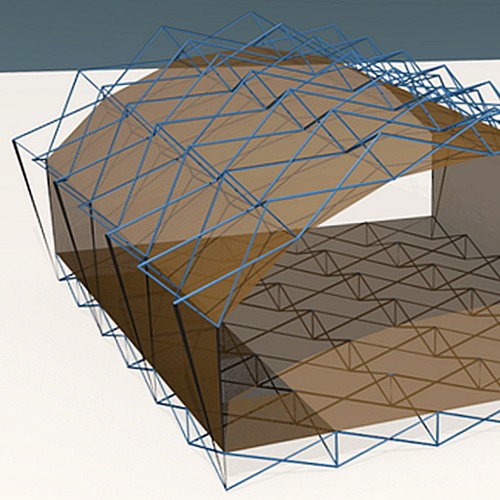
The use of expandable structures in the field of building began in the 1960s, based on the pioneering work of Emilio Pérez Piñero. They underwent significant developments at the end of the 20 th century, with typologies based on scissors or bundle modules. Until now, this typology has not been further enhanced, despite some very interesting contributions. These studies are usually based on straight bar expandable structures, although there are some interesting proposals based on the deployability of parallel arc systems, even in real buildings. However, other possible types of expandable structures have not been explored to date. In this paper, a new system for expandable structures is proposed, which opens new and interesting design possibilities based on the same folding principle. The system consists of deploying elements such as arches or frames with multiple intersections. Solutions for cylindrical vaults with horizontal axis joints and more complex geometries such as conoids are proposed, as well as domes with vertical and horizontal axis joints. Finally, other structures with special kinematic compatibility difficulties, such as concentric domes or toroids, are also studied.

Este artículo fue galardonado con el Tsuboi Award de la revista JIASS, que se otorgan desde 1991, por el artículo más meritorio publicado en la revista en el año 2019.


«Modified Bistable Modules for Bias Deployable Structures»
Freire-Tellado, Manuel; Muñoz-Vidal, Manuel; Pérez-Valcárcel, Juan. Structures 36(134):111-125. February 2022. DOI: https://doi.org/10.1016/j.istruc.2021.12.011

Abstract:
Bias deployable grids are meshes with two directions of rotation on the ground plan with respect to the edges. They offer benefits such as three-dimensional resistance with supports around the entire perimeter of a rectangular layout, and consist exclusively of load-bearing scissors as opposed to the usual combinations of load-bearing scissors and bracing scissors. However, their resistance to angular distortion is limited, and they require auxiliary elements to maintain the fully deployed position. Nevertheless, they are very promising solutions for medium-span emergency buildings.

This paper proposes a bistable module adapted to bias deployable structures. The geometrical incompatibilities of several modules are analysed together with their behaviour based on the kinematic models that were built, which alternate different types of nodes and different geometries of the perimeter scissors, making it possible to calibrate the level of incompatibility introduced. The dimensions of the nodes are also taken into account. The tests are checked against the results of several series of dynamic calculations.
«Construcción de una vivienda de madera con el sistema UBUILD»
Santiago Muñiz, Emilio Mosquera, Alberto Corral. Informes de la Construcción. Vol. 74, 565, e428. enero-marzo 2022. DOI: https://doi.org/10.3989/ic.87025

Abstract:
The wooden construction of a building located in Ramiráns (Ourense) is presented. The UBUILD construction system has been used for its development. This allows the construction of light frame Wood truss with a high degree of prefabrication in the workshop, leaving their own assembly tasks for work. Initially, it is only necessary to use basic tools and a high degree of job specialization is not necessary for the operators. This is achieved with the use of BIM and Numerical Control manufacturing techniques. This system allows it to be adapted to the needs of the user and the level of constructive quality or the insulation benefits necessary for its use as residential construction is not lost. The house has been in use for several months, allowing the validation of the techniques used in its design and construction
«Bias deployable grids with horizontal compound scissor-like elements: A geometric study of the folding/deployment process»
Freire-Tellado MJ., Muñoz-Vidal M., Pérez-Valcárcel J. International Journal of Space Structures. Vol. 37. Pag. 22-36. December 2021. DOI: https://doi.org/10.1177/09560599211064094

Abstract:
Bias deployable structural units are two-way structures arranged in a rotational pattern with respect to the edges. They have interesting advantages such as robust three-dimensional operation with supports around their entire base perimeter and the exclusive use of load-bearing scissor-like elements (SLEs). However, they do not have edge trims and their resistance to angular distortion is limited. This article proposes a series of deployable bi-stable structures that address these problems and incorporate new, resilient features. A method of analysing the incompatibilities of the structural unit is developed based solely on the geometric study of the deployment process, which allows the level of incompatibility of the proposal to be graduated, varying from stress-free structures to bi-stable structures. A kinematic model of one of the proposals allows the research undertaken to be contrasted.
A new reciprocal linkage for expandable emergency structures
J. Pérez-Valcárcel, F. Suárez-Riestra, M. Muñoz-Vidal, I. López-César, M. J. Freire-Tellado (2020). A new reciprocal linkage for expandable emergency structures. Structures. Volume 28, December 2020, 2023-2033. DOI: https://doi.org/10.1016/j.istruc.2020.10.008

Abstract:
Expandable structures have certain qualities in terms of lightness and transportability which make them very useful as emergency buildings, a research line that is being developed by the authors. However, these structures have some disadvantages due to their reduced rigidity and great deformability, issues that could limit their use. This paper analyzes a reciprocal linkage that considerably improves one of the main problems of expandable structures, which is their lack of rigidity. The extremely strict geometrical conditions for this proposed linkage and the mechanical behaviour are examined. Two series of tests were carried out, with specimens formed by four bars supported reciprocally around the proposed linkage. In the first case, the bars had their ends simply resting on the base and in the second one displacement was restricted at their ends. Theoretical analysis and the experimental tests results are also included. The tests make it possible to define the failure patterns of the different elements of the linkages, bars or bolts. The theoretical models and the experimental results show that the proposed reciprocal linkages are highly effective. Tests of plane scissor meshes were also carried out using reciprocal linkages, showing a very significant reduction in their displacements.
Keywords: Expandable structures; reciprocal linkages; lightweight structures; temporary buildings; emergency buildings.
«A new system of deployable structures with reciprocal linkages for emergency buildings»
J. Pérez-Valcárcel, M. Muñoz-Vidal, F. Suárez-Riestra, Isaac R. López-César, M. J. Freire-Tellado. Journal of Building Engineering 33. 2021.
DOI: https://doi.org/10.1016/j.jobe.2020.101609

Abstract:
Deployable structures are a good solution for emergency buildings, due to their lightness and compact nature which means they can be transported to where they are needed. Nevertheless, the deployable structures studied to date have the drawback of being too deformable, so that larger and therefore heavier sections had to be used. This paper proposes a new type of deployable structure that uses reciprocal linkages which give rise to greater strength and rigidity. The geometrical and mechanical conditions of the linkages are analysed, as several different types which perform better can be designed, and a calculation method is developed to analyse struc- tures of this type. The features and behaviour of a flat mesh with articulated reciprocal linkages are also compared analytically and experimentally. The theoretical calculations and experimental tests make it possible to prove the viability and efficacy of this new structural type.
«Deployable cylindrical vaults with reciprocal linkages for emergency buildings»
J. Pérez-Valcárcel, F. Suárez-Riestra, M. Muñoz-Vidal, I. López-César, M. J. Freire-Tellado (2020). Structures 33. Pag. 4461-4474. October 2021. DOI: https://doi.org/10.1016/j.istruc.2021.06.094
Abstract:
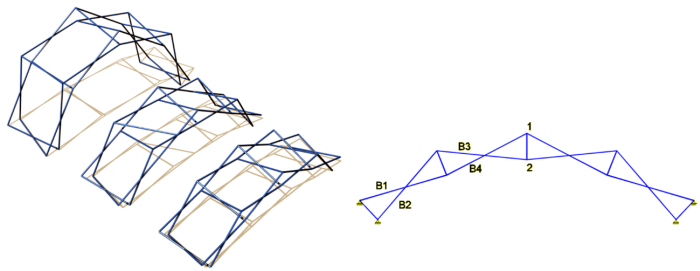
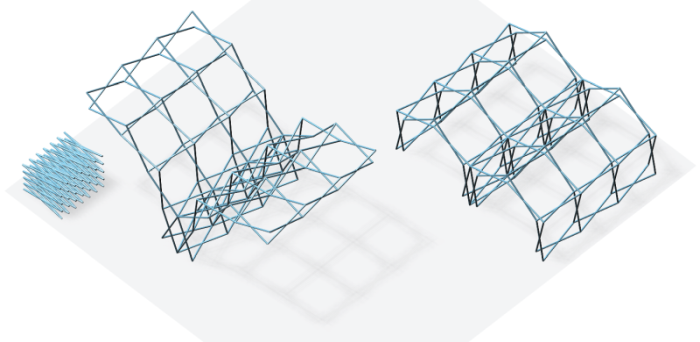
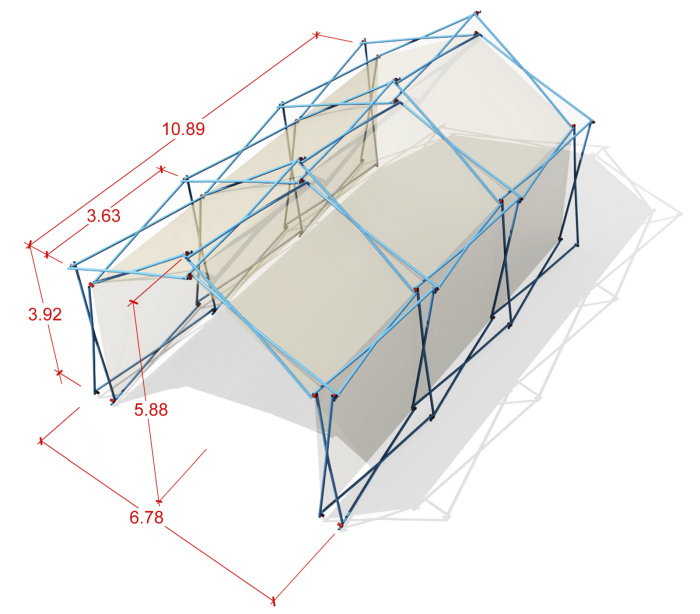
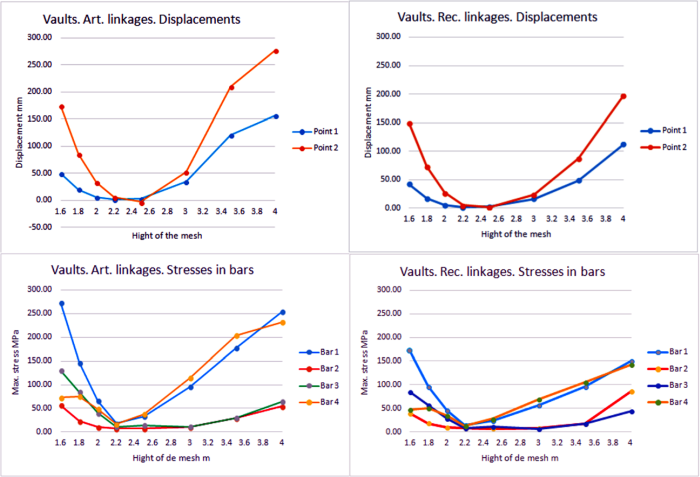
Deployable bar structures can improve their performance by using reciprocal linkages at their ends. This article will analyse this new system applied to cylindrical vaults. These structures are especially useful for emergency buildings due to their simplicity and ease of assembly and deployment. The constructive conditions are analysed and, in particular, the support conditions that allow all types of cylindrical vaults to be fixed to a horizontal floor. Construction systems with a straight scissor-like elements or imposed curvature are also analysed, comparing their behaviour. The models were submitted to a test campaign, comparing the results with those previously estimated from the theoretical analysis. From this comparison, the validity and adequacy of this type of deployable structures can be demonstrated, verifying the advantages of the use of reciprocal joints in vaults.
«Deployable bundle modulus structures with reciprocal linkages for emergency buildings»
Pérez-Valcárcel J., Muñoz-Vidal M., López César I., Suárez Riestra F., Freire Tellado M. (2021). Engineering Structures. Volume 244. October 2021. DOI: https://doi.org/10.1016/j.engstruct.2021.112803


Abstract:
Deployable structures are an ideal solution for emergency buildings because of their lightness and compactness, allowing them to be transported to wherever they are needed. Generally the most frequent solutions use Scissor-like-Elements (SLE), but in this case the use of bundle modules is proposed. These systems were developed by Pérez Piñero, but have hardly been used since then. The article analyses the problems they present, as well as their advantages in reducing the number of bars and linkages required, which allows for the design of simpler and more economical structures. The geometrical and mechanical conditions of the linkages for triangular and square modules are analysed, as well as the typologies that may arise. A calculation method is also developed to analyse this type of structure. Finally, the performance of a flat grid is analysed in an analytical and experimental way using reciprocal links at its ends. Both theoretical calculations and experimental tests allow us to demonstrate the viability and efficiency of this new type of structure.


«Deployable space grids with lockable joints»
Pérez-Valcárcel J., Muñoz-Vidal M., López César I., Suárez Riestra F., Freire Tellado M. (2021). International Journal of Space Structures. Volume 36, Issue 2. June 2021. DOI: https://doi.org/10.1177/09560599211002480

In this research, the use of deployable structures with lockable joints is proposed. Most of the deployable structures are based on scissors or bundle modules, but always using through joints. But in this case, the deployable structures will be analyzed with a novel system of self-locking joints that allow the formation of spatial meshes.

The great advantage is that the resulting structure works as active vector with the bars in tension or compression, without the bending that penalizes deployable structures with through joints. These spatial meshes can be deployed by joints arranged on the bars that have a self-locking mechanism that engages in the final open position. Different solutions are proposed for various uses, and data from theoretical and experimental analysis are provided.

«Modular temporary housing for situations of humanitarian catastrophe»
Pérez-Valcárcel J., Muñiz S., Mosquera E., Freire-Tellado M., Aragón J., Corral A. (2021). Journal Architectural Engineering. . Volume 27 Issue 2. June 2021. DOI: https://doi.org/10.1061/(ASCE)AE.1943-5568.0000471

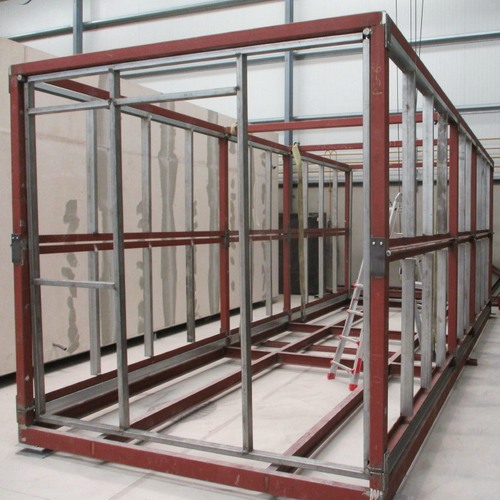
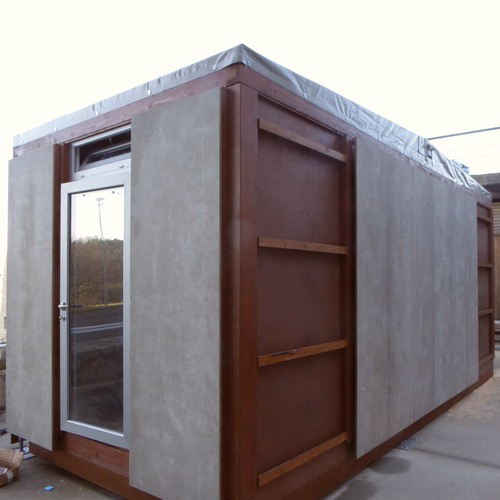
The search for architectural solutions for emergency situations is an important line of research. In this article, the most appropriate conditions for the different situations that can turn up after a disaster will be analyzed and proposals for temporary housing will be presented. These are possibly the most suitable solutions for developed countries.
The design and calculation of an experimental wooden module, built at the University School of Architecture in A Coruña, which has served as a prototype to analyse its viability in practice, will also be presented. Finally, there will be a critical review of the results and possible improvements detected.
«A new type of Reciprocal Structures: Deployable yurts for Emergency Situations»
Pérez-Valcárcel J, López César I., Muñoz-Vidal M., Suárez Riestra F., Freire Tellado M. (2021). Advances in Architecture and Civil Engineering, 2(1), 1-15: DOI: https://doi.org/10.31579/jaace.2021/002

Deployable structures are a good solution for emergency buildings due to their lightweight and compact characteristics that allow them to be transported to wherever they are needed, especially in emergency situations.
Generally, folding structures have been designed with modules comprised of straight bars, forming a scissor joint. They are efficient systems, although they have the disadvantage of being excessively deformable, requiring the use of large and consequently heavier sections.
Recently, interesting proposals have been made based on deployable systems with parallel arches and also with arches or frames with multiple intersections. Dome solutions have been proposed with vertical and horizontal axis joints with reciprocal support in the linkages that increase their efficiency.
In this document, a new system is proposed for deployable structures based on a similar system of multiple intersections, but composed of straight bars. This allows them to be applied to a traditional and highly effective design, the yurt. The deployable yurts developed have multiple applications for common types of structures used in emergency situations.
«Construcción izada: Condicionantes estructurales del sistema REVERSTOP»
Juan Pérez-Valcárcel, Manuel Muñoz-Vidal, Victor Hermo (2020). Informes de la Construcción, 72(559): e355.
DOI: https://doi.org/10.3989/ic.72993

Abstract:
A big problem for the construction of buildings is the construction in height, what supposes a risk for the workers and a greater cost. The patented REVERSTOP system allows the construction at ground level and the subsequent lifting of each plant. The upper level is the first to be built on the ground floor. This level is raised through hydraulic jacks and a new level is built under it. The subsequent phases allow building the entire building, always from the ground level. In this article we analyze the structural aspects of the system. In the case analyzed, the structure of the building consists of aluminum profiles that form the resistant walls, the floors and the roof, with the same element. The calculations that support the effectiveness of the solution and the experimental results obtained in the tests carried out within a research project are provided.
«Scissor-Hinged Deployable Structures Supported Perimetrally on Rectangular Bases»
M. J. Freire Tellado, M. Muñoz-Vidal, J. Pérez-Valcárcel (2020). Journal of the International Association for Shell and Spatial Structures Vol. 61 No. 2. June n. 204. 158-172. DOI: https://doi.org/10.20898/j.iass

Abstract:
Deployable bar structures on a rectangular base present the problems of closing the ends and longitudinal stabilization. Some proposals have been made to resolve them, mainly by creating mouths, but their application to composite geometries is problematic. On-the-bias deployable structures adequately solve both problems as they are supported around their entire perimeter, have a strong three-dimensional operation and only use load-bearing bars. The text analyses this type of deployable structures, their requirements and possibilities. A study on the combination of polar and translational units in a single deployable structure is then carried out, focusing on the study of on-the-bias deployable structures with perimeter polar modules that allow the effective height of the designs to be increased. Finally, the architectural possibilities of the system are studied, which make it possible to resolve overhangs, vertical openings in the roof, and T- or L-shaped ground plans, guaranteeing the modularity of the system.
«Estructuras desplegables de aspas para cubiertas inclinadas»
M. J. Freire-Tellado, M. Muñoz-Vidal, I. López-César, J. Pérez-Valcárcel. (2019). Informes de la Construcción, 71(556): e311.
DOI: https://doi.org/10.3989/ic.64120

Abstract:
La atención a la evacuación del agua de lluvia y a la protección de la estructura ante los agentes meteorológicos ha dado lugar a un conjunto de propuestas de estructuras desplegables de aspas sobre planta rectangular en las que estas estructuras definen limas y faldones de pendiente suficiente. El trabajo parte de la resolución del trazado de estructuras desplegables de aspas planas simétricas y base cuadrangular con directriz quebrada, garantizándose el correcto funcionamiento cinemático mediante la construcción de modelos. Se estudian desplegables con directrices poligonales, curvas compuestas y también combinaciones de curvas y rectas. Se repasan los problemas de estabilización de la solución en el estado desplegado, incorporando la cobertura textil y cables de arriostramiento. Finalmente se desarrollan y analizan geométrica y cinemáticamente una serie de propuestas con superficies de intradós y extradós diferentes y otro grupo de ellas en las que los sentidos de despliegue no siguen los ejes del recinto a cubrir.
«Estructuras desplegables para actividades lúdicas»
J. Pérez Valcarcel, M. Freire Tellado, M. Muñoz Vidal (2019) BAc. Boletín Académico. Revista De investigación Y Arquitectura contemporánea, Num. 9, pag. 129-146. DOI: https://doi.org/10.17979/bac.2019.9.0.4635

Abstract:
The paper reviews some different facility proposals developed for leisure activities or commercial exchange, such as fairs or markets, proposals for which the portability, lightness and ease of erection are determining conditions. Deployable structures suit very well these requirements, and some novel solutions of them are proposed. A brief review of the fabric covers, the folding systems of the textile cover and the bundle of bars is carried out. The typology of deployable structures with oblique modules is analysed, paying special attention to umbrella-type structures, pitched roofs and pyramidal domes. The three previous ones are considered types of great utility to construct transportable, simple and efficient enclosures for the development of leisure activities and of small commerce. They are also treasily adaptable to emergency situations, the main object of our research.
«Expandable covers of skew modules for emergency buildings»
J. Pérez-Valcárcel, M. Muñoz-Vidal, M. J. Freire-Tellado, Isaac R. López-César, F. Suárez-Riestra (2020). International Journal of Innovation Engineering and Science Research (ISSN: 2581-4591). Volume 4 Issue 5 September-October 2020

Abstract:
Deployable structures can be a good response to disaster situations, where it is necessary to provide services to a displaced population. They can be compacted into a lightweight and easily transportable package and deployed where needed providing an enclosure for use, quickly and efficiently. In this article, the possibilities of deployable structures of oblique modules are investigated, a subject little studied, but of great interest due to its many possibilities. The geometric conditions of the different modules and the typologies that can be considered are analyzed. The possibility of using the reciprocal links system developed by the authors is also estudied in these meshes. Finally, the performance of a pyramidal dome that uses reciprocal linkages at the ends of its bar, is analyzed in an analytical and experimental way. Both the theoretical calculations and the experimental tests allow demonstrating the viability and effectiveness of this structural type.
«Expandable bar structures for emergency situations»
J. Pérez-Valcárcel, M. Muñoz-Vidal, M. Freire-Tellado, D. Gómez-Magide & A. Casal-Rodríguez (2019) 4th International Conference On Structures & Architecture. Lisboa, Portugal. 2019. pp 809-815. Publicación electronica Structures and Architecture – Cruz (Ed.) © 2019 Taylor & Francis Group, London, ISBN 978-1-315-22912-6.

Abstract:
The deployable structures are formed by bars articulated at their ends and with an inner knot. They can be folded into a very compact package and transported easily. In their destination they can be deployed to a wide area and after their use can be picked up and trans- ported to another place. The proposed solutions are expandable bar structures, for cover medium and small size enclosures. They can effectively solve fairly large enclosures and can take advan- tage of the greenhouse effect to improve their bioclimatic conditions. They are especially suit- able for dining rooms, kitchens, meeting rooms, schools, etc. In the paper, several solutions have been designed. Three-dimensional x-cross meshes have been studied for larger enclosures, which allow broken and curved shapes. Solutions based on the use of flat x-cross frameworks have also been studied on several occasions. It is an easy and economical solution, with a sus- tainable building approach.
«Deployable structures of reciprocal crossed arches»
M. Muñoz-Vidal, I. López-César, J. Pérez-Valcárcel & F. Suárez-Riestra
(2019) 4th International Conference On Structures & Architecture. Lisboa, Portugal. 2019. pp 714-721. Publicación electronica Structures and Architecture – Cruz (Ed.) © 2019 Taylor & Francis Group, London, ISBN 978-1-315-22912-6.

Abstract:
The expandable structures are formed by pin-jointed bars at their ends that can be folded into a very compact package and transported easily. When they arrive at their destination they can be deployed covering a wide area, and when they are no longer needed, they can be picked up and transported to another place. The proposed structures merge the advantages of deployable structures and reciprocal structures. The use of smaller sections is compensated by increasing the number of arcs that make up the structure and the number of connections between them, which helps to a better distribute of the loads. Having several joints distributed along each arc also dras- tically decrease the bending stresses, which are very important in this type of structures. This typology that we are developing admits a quite wide formal diversity, obtaining that from a set of arcs folded in parallel, we can obtain deployed forms as diverse as semicircular vaults, ellipse and even toroids. In any case, a new line of solutions for rapid-deployment structures has been opened to enclosures from medium to large size using reduced section profiles.
«Modular housing for situations of humanitarian catastrophe»
J. Aragón Fitera & S. Muñiz Gómez, V. Hermo Sanchez, E. Mosquera Rey & A. Casal-Rodríguez (2019) 4th International Conference On Structures & Architecture. Lisboa, Portugal. 2019. pp 714-721. Publicación electronica Structures and Architecture – Cruz (Ed.) © 2019 Taylor & Francis Group, London, ISBN 978-1-315-22912-6

Abstract:
Although there is abundant bibliography regarding spontaneous, temporary and emergency shelters, in recent years, permanent camps for displaced people in European territory have become relevant. In this line the resources available, the technical requirements and standards for the emergency architecture have to evolve significantly. The group of Architectural Structures of the Universidad de a Coruña is developing a research project on Deployable and Modular Constructions for Situations of Humanitarian Catastrophe (CODEMOSCH)
«Modular temporary housing for situations of humanitarian catastrophe «
Pérez-Valcárcel J., Muñiz S., Mosquera E., Freire-Tellado M., Aragón J., Corral A. Journal architectural engineering. Volume 27 Issue 2. June 2021. https://doi.org/10.1061/(ASCE)AE.1943-5568.0000471
Abstract.
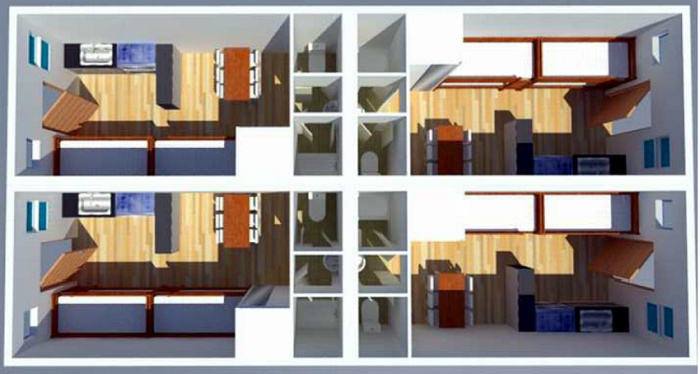
The search for architectural solutions for emergency situations is an important line of research. In this article, the most appropriate conditions for the different situations that can turn up after a disaster will be analyzed and proposals for temporary housing will be presented. These are possibly the most suitable solutions for developed countries. The design and calculation of an experimental wooden module, built at the University School of Architecture in A Coruña, which has served as a prototype to analyze its viability in practice, will also be presented. Finally, there will be a critical review of theresults and possible improvements detected.